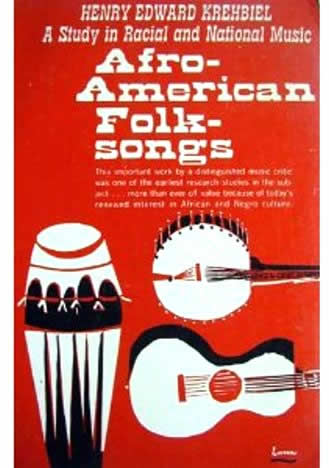
Afro-American Folksongs - online book

A Study In Racial And National Music

Includes Some Sheet Music & Lyrics.

By Henry Edward Krehbiel, Published By G. Schirmer New York, Circa 1913

Home | Main Menu | Singing & Playing | Order & Order Info | Support | Search | Coupon Codes


Like, share or bookmark this page


About This Book

THIS BOOK was written with the purpose of bringing a species of folksong into the field of scientific observation and presenting it as fit material for artistic treatment. It is a continuation of a branch of musical study for which the foundation was laid more than a decade ago in a series of essays with bibliographical addenda printed in the New York "Tribune," of which journal the author has been the musical reviewer for more than thirty years. The general subject of those articles was folksongs and their relation to national schools of composition. It had come to the writer's knowledge that the articles had been clipped from the newspaper, placed in envelopes and indexed in several public libraries, and many requests came to him from li­brarians and students that they be republished in book-form. This advice could not be acted upon because the articles were mere outlines, ground-plans, suggestions and guides to the larger work or works which the author hoped would the be the result of his instigation. Folksong literature has grown considerably since then, especially in Europe, but the subject of paramount interest to the people of the United States has practically been ignored. The songs created by the negroes while they were slaves on the plantations of the South have cried out in vain for scientific study, though "ragtime" tunes, which are their debased offspring, have seized upon the fancy of the civilized world. This popularity may be deplorable, but it serves at least to prove that a marvellous potency lies in the characteristic rhythmical element of the slave songs. Would not a wider and truer knowledge of their other characteristics as well lead to the creation of a better art than that which tickles the ears and stimulates the feet of the pleasure-seekers of London, Paris, Berlin and Vienna even more than it does those of New York? H.E.K 1913

Afro-American Folksongs, Index Page
Deduct 100 from the numbers show to get the original page numbers from the book.
Title Page
PREFACE
PREFACE
PREFACE
PREFACE
PREFACE
PREFACE
PREFACE
PREFACE
CONTENTS
CONTENTS
Chapter I Folksongs in General, The Characteristics of Folksongs.—Folksongs De­fined.—Creative Influences.—Folksong and Suffering. —Modes, Rhythms and Scales.—Russian and Finnish Music.—Persistency of Type.—Music and Racial Ties. —Britons and Bretons. - 0101
Page - 0102
Page - 0103
Page - 0104
Page - 0105
Page - 0106
Page - 0107
Page - 0108
Page - 0109
Page - 0110
Chapter II. Songs of the American Slaves, — Originality of the Afro-American Folksongs.—Dr. Wallaschek and His Contention.—Extent of the Imi­tation in the Songs.—Allusions to Slavery.—How the Songs Grew.—Are They Entitled to be Called Ameri­can.—The Negro in American History. - 0111
Page - 0112
Page - 0113
Page - 0114
Page - 0115
Page - 0116
Page - 0117
Page - 0118
Page - 0119
Page - 0120
Page - 0121
Page - 0122
Page - 0123
Page - 0124
Page - 0125
Chapter III. Religious Character of the Songs, The Paucity of Secular Songs among the Slaves.— Campmeetings, "Spirituals" and "Shouts."—Work-Songs of the Fields and Rivers.—Lafcadio Hearn and Negro Music.—African Relics and Voodoo Ceremonies. - 0126
Page - 0127
Page - 0128
Page - 0129
Page - 0130
Page - 0131
Page - 0132
Page - 0133
Page - 0134
Page - 0135
Page - 0136
Page - 0137
Page - 0138
Page - 0139
Page - 0140
Page - 0141
Chapter IV. Modal Characteristics of the Songs, An Analysis of Half a Thousand Negro Songs.— Division as to Modes.—Overwhelming Prevalence of Major.—Psychology of the Phenomenon.—Music as a Stimulus to Work.—Songs of the Fieldhands and Rowers. - 0142
Page - 0143
Page - 0144
Page - 0145
Page - 0146
Page - 0147
Page - 0148
Page - 0149
Page - 0150
Page - 0151
Page - 0152
Page - 0153
Page - 0154
Page - 0155
Chapter V. Music Among the Africans, The Many and Varied Kinds of African Slaves.— Not All Negroes.—Their Aptitude and Love for Music. —Knowledge and Use of Harmony.—Dahomans at Chicago.—Rhythm and Drumming.—African Instru­ments. - 0156
Page - 0157
Page - 0158
Page - 0159
Page - 0160
Page - 0161
Page - 0162
Page - 0163
Page - 0164
Page - 0165
Page - 0166
Page - 0167
Page - 0168
Page - 0169
Chapter VI. Variations from the Major Scale, Peculiarities of Negro Singing.—Vagueness of Pitch in Certain Intervals.—Fractional Tones in Primitive Music.—The Pentatonic Scale.—The Flat Seventh.— Harmonization of Negro Melodies. - 0170
Page - 0171
Page - 0172
Page - 0173
Page - 0174
Page - 0175
Page - 0176
Page - 0177
Page - 0178
Page - 0179
Page - 0180
Page - 0181
Page - 0182
Chapter VII. Minor Variations and Characteristic Rhythms , Vagaries in the Minor Scale.—The Sharp Sixth.— Orientalism.—The "Scotch" Snap.—A Note on the Tango Dance.—Even and Uneven Measures.—Adjusting Words and Music, - 0183
Page - 0184
Page - 0185
Page - 0186
Page - 0187
Page - 0188
Page - 0189
Page - 0190
Page - 0191
Page - 0192
Page - 0193
Page - 0194
Page - 0195
Page - 0196
Page - 0197
Page - 0198
Page - 0199
Chapter VIII. Structural Features of the Poems. Funeral Music, Improvization.—Solo and Choral Refrain.—Strange Funeral Customs.—Their Savage Prototypes.—Messages to the Dead.—Graveyard Songs of the American Slaves. - 0200
Page - 0201
Page - 0202
Page - 0203
Page - 0204
Page - 0205
Page - 0206
Page - 0207
Page - 0208
Page - 0209
Page - 0210
Page - 0211
Chapter IX. Dances of the American Negroes, Creole Music—The Effect of Spanish Influences.— Obscenity of Native African Dances.—Relics in the Antilles.—The Habanera.—Dance-Tunes from Mar­tinique - 0212
Page - 0213
Page - 0214
Page - 0215
Page - 0216
Page - 0217
Page - 0218
Page - 0219
Page - 0220
Page - 0221
Page - 0222
Page - 0223
Page - 0224
Page - 0225
Page - 0226
Chapter X. Songs of the Black Creoles, The Language of the Afro-American Folksongs.— Phonetic Changes in English.—Grammar of the Creole Patois.—Making French Compact and Musi­cal.—Dr. Mercier's Pamphlet.—Creole Love-Songs. - 0227
Page - 0228
Page - 0229
Page - 0230
Page - 0231
Page - 0232
Page - 0233
Page - 0234
Page - 0235
Page - 0236
Page - 0237
Page - 0238
Page - 0239
Chapter XI. Satirical Songs of the Creoles, A Classification of Slave Songs.—The Use of Music in Satire.—African Minstrels.—The Carnival in Mar­tinique.—West Indian Ptllards—Old Boscoyo's Song in New Orleans.—Conclusion.—An American School of Composition. - 0240
Page - 0241
Page - 0242
Page - 0243
Page - 0244
Page - 0245
Page - 0246
Page - 0247
Page - 0248
Page - 0249
Page - 0250
Page - 0251
Page - 0252
Page - 0253
Page - 0254
Page - 0255
Appendix of Ten Characteristic Songs 157 - 0257
Page - 0258
Page - 0259
Page - 0260
Page - 0261
Page - 0262
Page - 0263
Page - 0264
Page - 0265
Page - 0266
Page - 0267
Page - 0268
Page - 0269
Index - 0271
Page - 0272
Page - 0273
Page - 0274
Page - 0275
Page - 0276